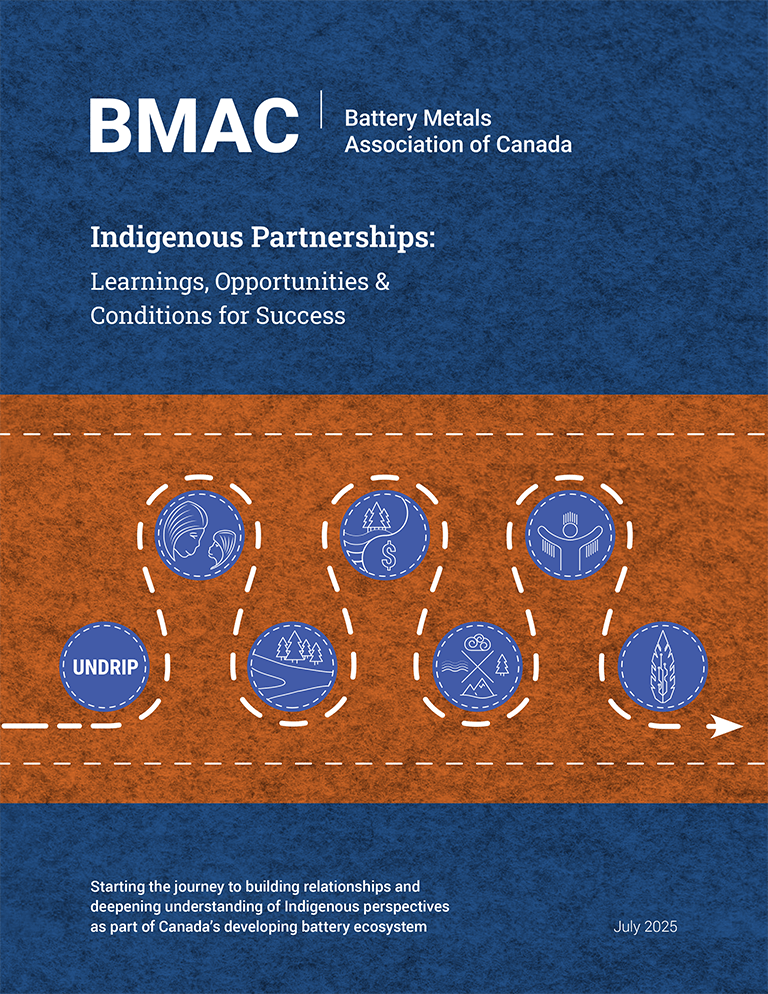
Indigenous Partnerships: Learnings, Opportunities & Conditions for Success

An offering in the spirit of learning, reflection, and relationship-building

This report is the result of a collaborative effort between the Battery Metals Association of Canada (BMAC) and the Energy Futures Lab (EFL), guided by the leadership and lived experience of an Indigenous Advisory Circle.

It reflects what we heard and learned through two workshops that brought Indigenous leaders, government, and industry participants together to explore the role of Indigenous rights, governance, and partnerships in shaping Canada’s emerging battery ecosystem.

We offer this report not as a roadmap or final word — but as a learning journey. It is grounded in humility, and in a commitment to supporting an energy transition that upholds Indigenous rights, knowledge systems, and leadership.

As we work toward a more just, sustainable, and inclusive industry, we hope this report can serve as a starting point for continued conversation, reflection, and action.

Common Themes

Throughout this work a number of informative common themes emerged that can provide the basis for co-creating pathways forward to developing meaningful relationships and equitable partnerships.

Moving Beyond Words to Actions

Demonstrating genuine, collaborative action is a building block of strong relationships and essential for fostering trust and forming partnerships: this takes time and must be rooted in the spirit of reciprocity.

Below are examples of opportunities that taking action presents, along with conditions for successful partnerships that organizations throughout the battery value chain can reflect on.

By considering these examples and identifying potential barriers to advancing partnerships, organizations may uncover new pathways to creating meaningful and mutually beneficial relationships.

Seven Opportunities of Partnerships

Take meaningful action to inspire and demonstrate what is possible and reinforcing our industry reputation and brand.

Work in ways that center Indigenous knowledge, wisdom and teachings, including localized land and environmental considerations to inform infrastructure, site decisions and industry technical processes.

Respond to the expectations of investors who are increasingly curious about community support and relations to understand project risk, impact and performance.

Through equity sharing agreements with Indigenous communities and organizations such as the Alberta Indigenous Opportunities Corporation (AIOC).

Uphold obligations to Free, Prior and Informed Consent (FPIC) as an inherent right of Indigenous Peoples, and processes that provide opportunities to strengthen relations, lower project risks, and align the objectives of Indigenous communities and corporations.

Foster an environment where Indigenous knowledge is honoured throughout the project cycle and beyond by hiring local people for leadership, operations, expertise, contracting and business.

The Government of Canada adopted the United Nations Declaration on the Rights of Indigenous Peoples (UNDRIP) into legislation in 2021.

Seven Conditions for Successful Partnerships

Discomfort is normal and a sign that we are exploring something new to us. If we approach this with curiosity and openness it may result in new solutions and ideas.

Walking with humility acknowledges there is much to be learned and that building trust and relationships takes time.

Deepen understanding of where we are and how we got here, consent, continued intergenerational impacts, historical and ongoing connections to land.

Explicit attention to worldview, most often a dominant, Western perspective (offered as an observation, rather than criticism) in decision-making is necessary to uproot assumptions and understand the realities and lived experiences of Indigenous communities.

Each Nation best understands their realities and needs. Decision-making about development options and project leadership should be based on this understanding. A framework for decision making that is shared by many Indigenous communities is Seven Generations Thinking which considers the impact of decisions made today on future generations.

Be informed about ancestral, inherent and constitutionally protected rights, responsibilities to FPIC and other key reports, recommendations during and beyond lifecycle of projects and what it means to work in relationship.

This looks different for each Nation and Community (self-determination) and is best determined by the voices of partners and communities involved.


We invite you to consider how these opportunities and conditions could be relevant in your work and help to shape the future of Canada’s battery industry.  

This worksheet can be used to guide your reflection and capture your thoughts.

With Special Thanks To:

Alberta Innovates logo
battery metals association of Canada logo
energy futures lab logo
Prairies Economic Development Canada logo

Resources & References

National Centre for Truth and Reconciliation

Truth and Reconciliation Commission Reports: https://nctr.ca/records/reports/

Call to Action #92 for Corporate Canada

We call upon the corporate sector in Canada to adopt the United Nations Declaration on the Rights of Indigenous Peoples as a Reconciliation framework and to apply its principles, norms, and standards to corporate policy and core operational activities involving Indigenous peoples and their lands and resources. This would include, but not be limited to, the following:
  1. Commit to meaningful consultation, building respectful relationships, and obtaining the free, prior, and informed consent of Indigenous peoples before proceeding with economic development projects.
  2. Ensure that Aboriginal peoples have equitable access to jobs, training, and education opportunities in the corporate sector, and that Aboriginal communities gain long-term sustainable benefits from economic development projects.
  3. Provide education for management and staff on the history of Aboriginal peoples, including the history and legacy of residential schools, the United Nations Declaration on the Rights of Indigenous Peoples, Treaties and Aboriginal rights, Indigenous law, and Aboriginal-Crown relations. This will require skills based training in intercultural competency, conflict resolution, human rights, and anti-racism.

United Nations Declaration on the Rights of Indigenous Peoples

United Nations Declaration on the Rights of Indigenous Peoples Act: https://laws-lois.
justice.gc.ca/eng/acts/U-2.2/

The Government of Canada adopted the United Nations Declaration on the Rights of Indigenous Peoples (UNDRIP) into legislation in 2021. This legislation advances
the implementation of the Declaration as a key step in renewing the Government
of Canada’s relationship with Indigenous peoples.

General Literacy

University of Alberta Indigenous Canada online program

Community Engagement

University of Manitoba Working in Good Ways

Recognizing Rights and Titles

First Nations Major Projects Coalition, on Critical Minerals

Loan Guarantee Programs

Indigenous Equity Investment

Procurement

Canadian Minerals and Metals Plan, Local Procurement Checklist.

Global Standards

Works Cited

Ferland, N., Chen, A., & Villagrán Becerra, G. (2021). Working in good ways: a framework and resources for Indigenous community engagement. Community Engaged Learning, University of Manitoba.

Subscribe to BMAC’s mailing list to receive the latest industry information and quarterly newsletter.

"*" indicates required fields

This field is for validation purposes and should be left unchanged.